
If your preschooler suddenly fights bedtime, drops naps, or wakes at odd hours, you are not dealing with a behavior problem. You are watching preschooler sleep architecture explained in real time through your child’s body. Sleep architecture, the biological structure of sleep stages your child cycles through each night, changes dramatically between ages 3 and 5 as the brain matures. Understanding what is actually happening inside those sleep cycles gives you a clearer map for responding, adjusting routines, and stopping the guesswork.
Table of Contents
- Key Takeaways
- Preschooler sleep architecture explained: the basics
- How much sleep preschoolers actually need
- When naps disappear: the transition no one warns you about
- What sleep does to your preschooler’s brain and behavior
- Building routines that protect sleep architecture
- My honest take after years of sleep consulting
- How Dreamylittlessleepconsulting can help your family sleep better
- FAQ
Key Takeaways
| Point | Details |
|---|---|
| Sleep stages shift with age | Preschoolers cycle through NREM and REM sleep in roughly 60-minute cycles that change as the brain matures. |
| Total sleep need is 10 to 13 hours | Ages 3 to 5 require this amount across the full day, including any remaining nap time. |
| Nap dropping is developmental | Most preschoolers stop napping between ages 3 and 5, requiring an earlier bedtime to protect total sleep. |
| Sleep directly shapes cognition | Even 15 extra minutes of sleep improves executive function more than replacing that time with physical activity. |
| Routine stability is the biggest lever | Consistent bed and wake times are the most practical way to support healthy sleep architecture at home. |
Preschooler sleep architecture explained: the basics
Most parents think of sleep as one long stretch of rest. It is not. Sleep is a structured, repeating cycle of distinct stages, and understanding preschool sleep cycles starts with knowing what those stages actually do.
Sleep divides into two main categories. NREM sleep (non-rapid eye movement) is the deeper, quieter phase. It includes light NREM and deep slow-wave sleep, which is the stage where the body repairs tissue, releases growth hormone, and the brain consolidates what your child learned that day. REM sleep (rapid eye movement) is the active dreaming phase. The brain is nearly as busy during REM as when your child is awake, and this stage plays a major role in emotional processing and memory.
Here is what makes preschoolers different from infants. Newborns spend roughly 50% of their sleep in REM. By age 3, that proportion has dropped significantly as NREM deep sleep takes up more of the cycle. Sleep architecture matures over the first years of life, with changing proportions of REM and deep NREM reflecting active brain development. The slow-wave activity you cannot see, measured in the 0.75 to 4.25 Hz frequency range on brain scans, is a direct marker of cortical maturation. In plain terms: the depth of your child’s sleep is a sign of a healthy, growing brain.
A typical preschooler completes sleep cycles of about 60 minutes, shorter than the adult 90-minute cycle. Each cycle moves through light NREM, deep NREM, and then REM before restarting. The first half of the night is dominated by deep NREM sleep. The second half shifts toward more REM. This is why a preschooler who wakes at 5 a.m. and cannot go back to sleep is often cutting off their most REM-rich period, which matters for emotional regulation the next day.
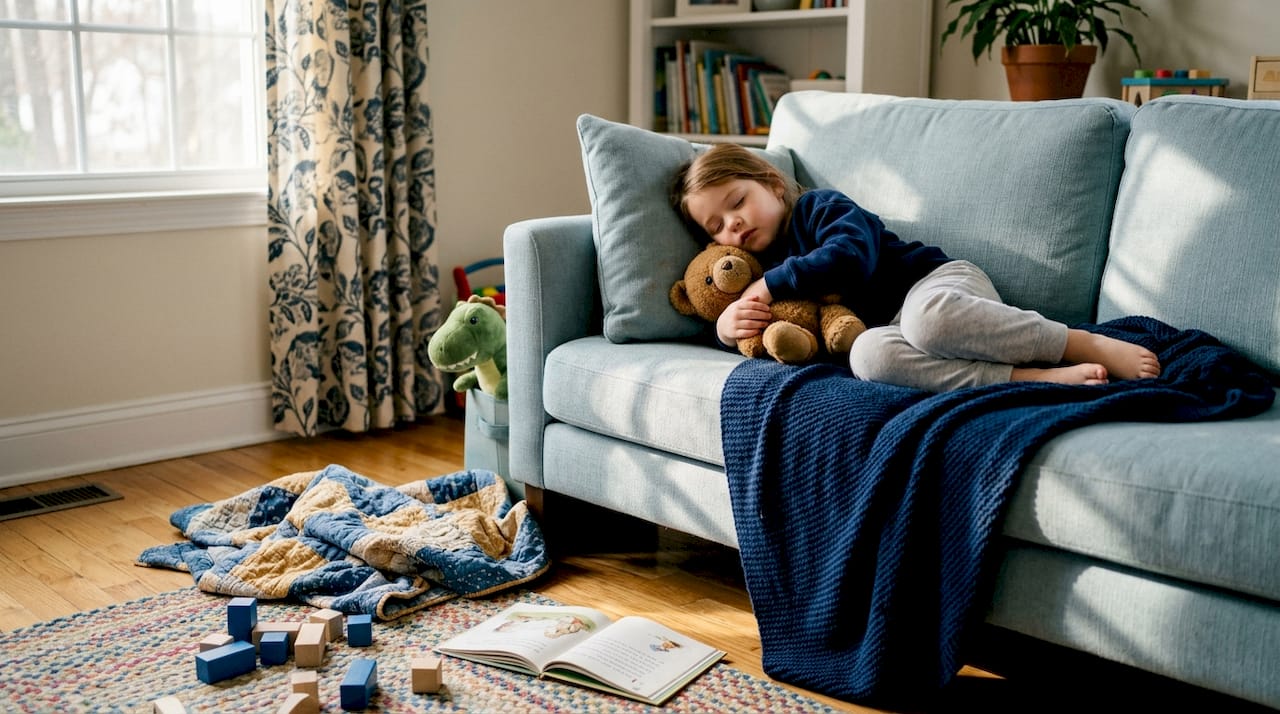
Pro Tip: If your child wakes up cranky and emotionally reactive in the morning, look at what time they are waking up. An early wake before 6 a.m. often cuts into the REM-heavy second half of the night, which directly affects mood.
How much sleep preschoolers actually need
Before you can support your child’s sleep architecture, you need to know the baseline. Preschoolers aged 3 to 5 require 10 to 13 hours of total sleep across 24 hours, including any naps. That range is not arbitrary. It reflects the brain’s demand for adequate NREM and REM time to complete its developmental work.
Here is how that typically breaks down by age:
| Age | Nighttime Sleep | Nap | Total |
|---|---|---|---|
| 3 years | 10 to 11 hours | 1 to 2 hours | 11 to 13 hours |
| 4 years | 10 to 11 hours | 0 to 1 hour | 10 to 12 hours |
| 5 years | 10 to 11 hours | None (most) | 10 to 11 hours |
The ideal bedtime window for most preschoolers falls between 7:30 and 8:30 p.m. This aligns with the natural rise in melatonin that occurs after sunset in young children. Pushing bedtime later does not mean your child sleeps in. It usually means they get less total sleep and wake at the same time anyway.
A few signs your preschooler is not getting enough total sleep:
- Difficulty waking in the morning without significant effort
- Emotional meltdowns that seem disproportionate to the trigger
- Hyperactivity in the late afternoon (a counterintuitive sign of overtiredness)
- Falling asleep in the car on short trips
Consistent sleep duration matters because the brain cannot simply “catch up” on missed deep NREM or REM in a single long weekend sleep. The architecture needs to repeat nightly to do its job.
When naps disappear: the transition no one warns you about
The nap drop is one of the most misunderstood transitions in early childhood. Parents often interpret it as their child simply “not needing sleep anymore.” What is actually happening is a shift in how sleep pressure builds throughout the day.
Most preschoolers drop their nap between ages 3 and 5, though the process is rarely clean. For weeks or months, your child may nap some days and resist on others. This inconsistency is normal and reflects the gradual reduction in daytime sleep pressure as the brain matures.
The critical mistake parents make during this transition is keeping bedtime the same. When a nap disappears, the child loses one to two hours of sleep that were previously part of their total. Without an earlier bedtime, that sleep debt accumulates fast. Here is what to watch for and do:
- Watch for the “false energy” window. Children who are overtired often get a second wind between 6 and 7 p.m. If you miss this window, the cortisol spike that follows makes falling asleep harder.
- Move bedtime 30 to 45 minutes earlier on days your child skips the nap. You do not need to do this permanently. Just respond to the day.
- Offer a “quiet time” instead of a forced nap. Thirty minutes of calm, low-stimulation activity in a dim room allows the brain to rest even without full sleep.
- Track mood and behavior, not just sleep time. A child who napped but woke up grumpy may have had a fragmented nap that disrupted their architecture more than no nap would have.
Pro Tip: During the nap transition, protect the 7 to 7:30 p.m. bedtime window even if your child seems fine. Adjusting bedtime earlier during nap dropping protects sleep continuity and reduces delayed sleep onset risk.
What sleep does to your preschooler’s brain and behavior
The impact of sleep on preschoolers goes well beyond rest. Sleep is when the brain does its most important work for learning and emotional regulation.
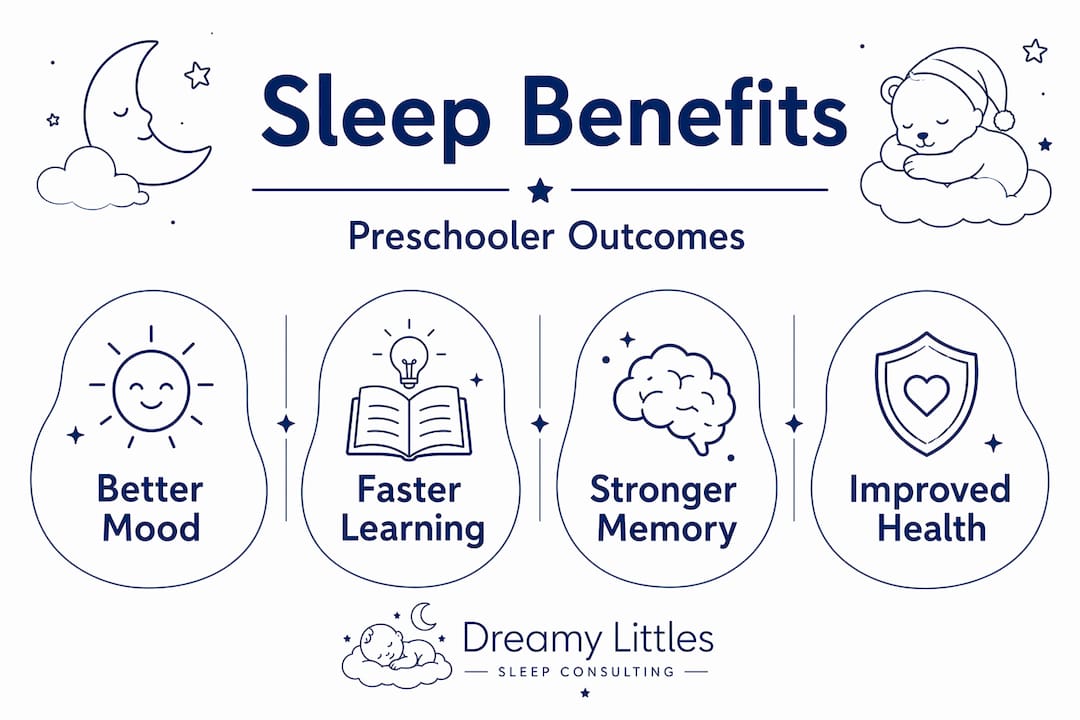
Research published in 2026 found that sleep accounts for about 42% of a preschooler’s day, and replacing just 15 minutes of sedentary time with sleep produced measurable improvements in cognitive flexibility and executive function. That is the ability to switch between tasks, hold information in working memory, and control impulses. These are the exact skills your child needs to succeed in preschool and kindergarten.
“Small increases in preschooler sleep can yield measurable executive function benefits, highlighting sleep’s unique cognitive role.” — Sleep, sedentary behavior, and physical activity: Executive function in preschool children
The emotional benefits are just as significant. REM sleep activates the amygdala, the brain’s emotional processing center, in a way that helps children work through stress without being overwhelmed by it. Sleep also regulates neurotransmitters like norepinephrine and serotonin, which directly influence mood stability. A child who sleeps well is not just less tired. They are neurochemically better equipped to handle frustration, transitions, and social challenges.
Here is what healthy sleep architecture supports in preschoolers:
- Cognitive flexibility: The ability to shift attention and adapt to new rules or situations
- Inhibitory control: Resisting impulses, waiting their turn, managing frustration
- Memory consolidation: Locking in new words, concepts, and skills learned during the day
- Emotional resilience: Recovering from upsets more quickly and with less intensity
These are not soft benefits. They are measurable outcomes tied directly to how much quality sleep your child gets each night.
Building routines that protect sleep architecture
The good news is that you do not need a sleep lab to support your preschooler’s sleep architecture. The main levers you control at home are routine stability, total sleep time, and nap timing. Here is how to use them well.
Consistent bed and wake times are the single most powerful tool. The brain’s circadian rhythm, its internal clock, thrives on predictability. When bedtime shifts by more than 60 minutes on weekends, the body’s sleep pressure and melatonin timing get thrown off, making Monday night bedtime a battle. Keep the window tight.
Your sleep environment checklist:
- Temperature: Cool rooms between 65 and 70 degrees Fahrenheit support deeper NREM sleep
- Light: Blackout curtains reduce early morning light exposure that triggers early waking
- Sound: White noise at a consistent low volume helps mask household sounds during light sleep transitions
- Screens: Avoid screens for at least 60 minutes before bed. Blue light suppresses melatonin and delays sleep onset
A calming bedtime routine of 20 to 30 minutes signals the brain to begin winding down. The sequence matters more than the specific activities. Bath, pajamas, two books, and a song works because it is predictable, not because of any magic in the bath itself. Predictability reduces cortisol and allows melatonin to rise naturally.
Pro Tip: When you notice your child taking longer than 20 minutes to fall asleep most nights, that is a signal the bedtime is too late, not that they need less sleep. Try moving it 15 minutes earlier for a week and observe the difference.
Unstable sleep schedules disrupt circadian rhythms and cause harder sleep onset and fragmented sleep. Consistency across weekdays and weekends protects the architecture your child’s brain is working hard to build. For more on navigating the toddler-to-preschool sleep transition, the toddler sleep guide at Dreamylittlessleepconsulting covers the overlap between these stages in practical detail.
My honest take after years of sleep consulting
I have worked with hundreds of families, and the shift that changes everything for parents is not a new technique. It is understanding the biology.
When I started integrating EEG research on slow-wave activity and REM proportions into how I explained sleep to families, something unexpected happened. Parents stopped fighting the process. Once a caregiver understands that their child’s perceived sleep problems may actually be normal developmental transitions, the anxiety drops. And when anxiety drops, the bedtime battles often ease too. Children read their parents’ energy.
What I have learned is that most preschooler sleep struggles are not behavioral at their core. They are biological transitions that happen to look like defiance or manipulation. The nap drop, the bedtime resistance, the early morning waking. These are not your child pushing limits. They are your child’s brain reorganizing itself.
The families who get the best results are not the ones who apply the strictest routines. They are the ones who understand why the routine works and can adapt it when the child’s needs shift. That flexibility, grounded in real knowledge of sleep stages, is what I try to give every family I work with.
— mara
How Dreamylittlessleepconsulting can help your family sleep better
Understanding sleep architecture is a powerful first step. Applying it to your specific child, with their unique temperament, schedule, and sleep history, is where most parents get stuck.

At Dreamylittlessleepconsulting, every family starts with a thorough sleep assessment that looks at your child’s current sleep patterns, nap history, bedtime routine, and environment. From there, a personalized plan is built around your child’s age and your family’s values. There is no one-size-fits-all script here. If you are in the middle of the nap transition, dealing with bedtime resistance, or just want to make sure your preschooler’s sleep is supporting their development, the sleep consultant services at Dreamylittlessleepconsulting offer exactly that kind of tailored support. You can also explore the full range of sleep coaching packages to find the right fit for your family’s needs and timeline.
FAQ
What is sleep architecture in preschoolers?
Sleep architecture refers to the structure and sequence of sleep stages, including NREM and REM sleep, that a child cycles through during the night. In preschoolers, these cycles last about 60 minutes and change in proportion as the brain matures.
How many hours of sleep does a 4-year-old need?
Most 4-year-olds need 10 to 12 hours of total sleep across 24 hours. Nighttime sleep typically accounts for 10 to 11 hours, with a short nap or quiet rest period making up the remainder for children who still nap.
Why does my preschooler fight bedtime even when tired?
Bedtime resistance often signals that the bedtime is too late and the child has moved past the optimal sleep window into an overtired state. A cortisol spike from overtiredness makes falling asleep harder. Moving bedtime 15 to 30 minutes earlier frequently resolves this.
What are common sleep issues in preschoolers?
Common sleep issues in preschoolers include bedtime resistance, night wakings, early morning waking, and difficulty transitioning away from naps. Many of these reflect normal developmental changes in sleep architecture rather than behavioral problems.
Does dropping naps hurt my preschooler’s sleep?
Not if you adjust bedtime accordingly. When a preschooler drops their nap, moving bedtime 30 to 45 minutes earlier protects total sleep time and prevents the sleep debt that leads to fragmented nighttime sleep and emotional dysregulation the next day.