
Every night feels like a negotiation you didn’t sign up for. Your preschooler clings, cries, or calls out repeatedly, and you’re running on empty wondering what you’re doing wrong. This guide to preschooler sleep anxiety walks you through exactly why this happens, what’s driving the fear, and what you can do tonight to start turning things around. You’ll find behavioral strategies, routine-building tools, and honest guidance on when to call in extra support. Nothing here is generic. Everything is built for the specific, exhausting reality of helping preschoolers with sleep issues.
Table of Contents
- Key takeaways
- Understanding preschooler sleep anxiety
- Building a calming bedtime routine
- Step-by-step strategies for bedtime anxiety
- Common mistakes and how to avoid them
- When to seek professional support
- My take on what actually works
- How Dreamylittlessleepconsulting can help
- FAQ
Key takeaways
| Point | Details |
|---|---|
| Anxiety has real roots | Preschool sleep fears stem from imagination, separation anxiety, and nervous system sensitivity, not defiance. |
| Routine is your first tool | A consistent, calming bedtime routine signals safety to your child’s nervous system every single night. |
| Validation beats dismissal | Acknowledging your child’s fear without confirming it builds confidence and reduces bedtime resistance faster. |
| Gradual steps work best | Slow parental withdrawal and gentle limits build independence without triggering more anxiety. |
| Know when to get help | Persistent, intense sleep anxiety that affects daytime functioning deserves professional evaluation and support. |
Understanding preschooler sleep anxiety
Before you can fix something, you need to understand what you’re actually dealing with. Sleep anxiety in preschoolers is not a phase to wait out or a behavior to punish. It’s a real, developmentally rooted experience that deserves your attention.
What’s actually happening at bedtime
Between ages three and five, children’s imaginations explode. That’s wonderful during the day and genuinely difficult at night. The same brain that creates elaborate pretend worlds also conjures monsters under the bed and worries about being alone. Separation anxiety, which peaks in toddlerhood but often resurfaces in preschool years, adds another layer. Your child isn’t being manipulative. They’re scared, and their nervous system is responding accordingly.
Some children are also more sensitive by temperament. They process sensory information more intensely, feel emotions more deeply, and need more support to wind down. Bedtime anxiety stems from this combination of imaginative growth and the desire for autonomy, and dismissing it tends to make things worse, not better.
Common signs of sleep anxiety in preschoolers
Watch for these patterns:
- Repeated requests for water, bathroom trips, or “one more hug” at bedtime
- Crying or clinging when you try to leave the room
- Complaints of stomachaches or headaches that appear only at night
- Waking in the middle of the night and refusing to go back to sleep alone
- Resistance that escalates when routines change or family stress increases
It’s worth distinguishing sleep anxiety from other sleep problems like sleep apnea or restless leg syndrome. Persistent sleep difficulties with loud snoring and daytime behavior issues may point to a medical condition, not anxiety. If you’re unsure, your pediatrician is the right first call.
Building a calming bedtime routine
A predictable routine is not just a nice idea. It’s a biological tool. Consistent sleep and wake times regulate your child’s internal clock and give their nervous system a reliable signal that safety is coming. Anxious children especially need that signal repeated the same way, night after night.
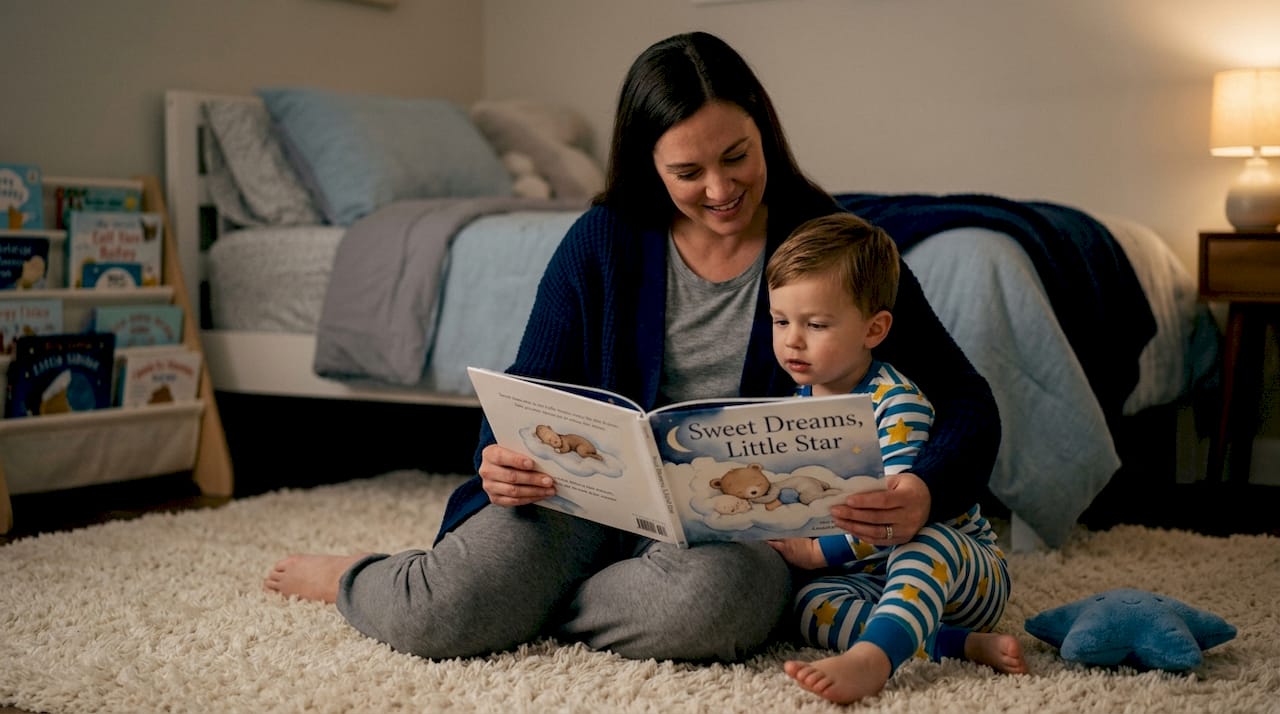
Think of it as building a “sensory on-ramp” to sleep. A succession of low-stimulation cues helps an anxious child transition from the energy of the day to the quiet of sleep without triggering a fight-or-flight response. The goal is to layer calming sensory experiences so the body knows what’s next before the brain has to think about it.
Here’s a sample routine framework that works well for most preschoolers:
| Time before bed | Activity | Why it helps |
|---|---|---|
| 45 minutes | Bath or warm shower | Lowers core body temperature, signals wind-down |
| 30 minutes | Dim lights, quiet play | Reduces visual stimulation and cortisol |
| 20 minutes | Reading physical books together | Builds connection and replaces screen time |
| 10 minutes | Comfort object, soft nightlight on | Provides security anchors for the night |
| 5 minutes | Predictable goodbye ritual | Creates a reliable, loving separation cue |
Technology before bedtime stimulates the brain in ways that work directly against this wind-down process. Tablets, TV, and interactive toys all delay the nervous system’s ability to settle. Physical books, soft music, and low lighting do the opposite.
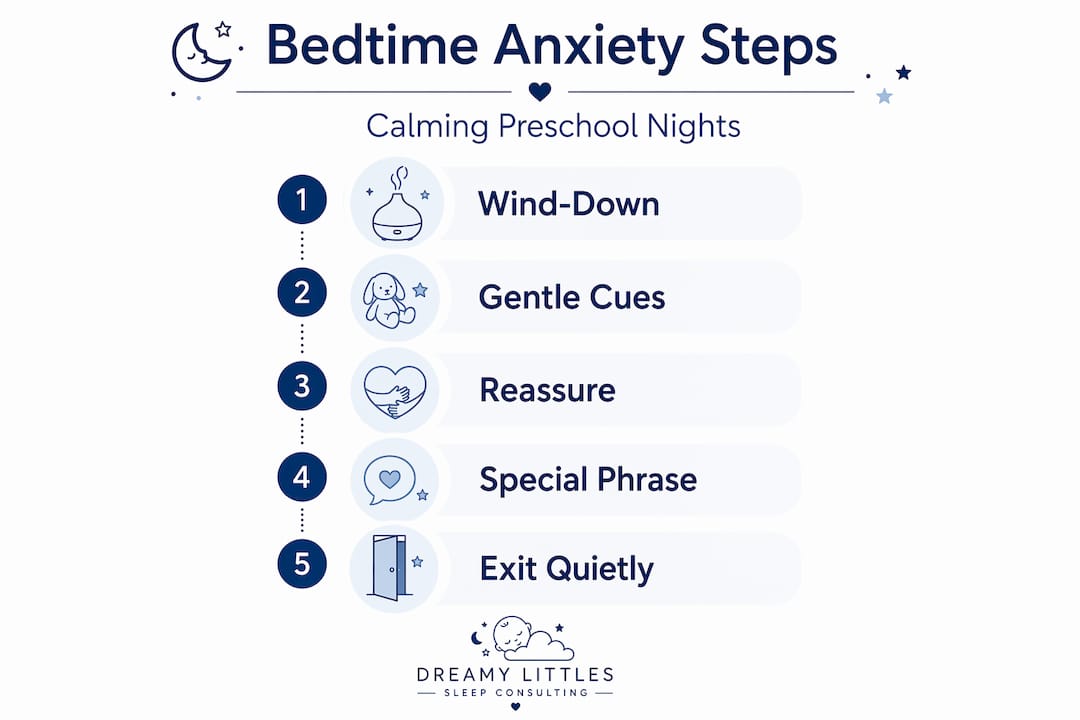
Pro Tip: Pick a “special goodbye phrase” you say every single night at the moment you leave the room. Something like “I love you, sleep tight, see you in the morning.” Repetition makes it a safety cue, not just words.
Step-by-step strategies for bedtime anxiety
Once your routine is in place, you need behavioral tools to use inside that routine and when things go sideways. These strategies are grounded in how anxious preschoolers actually process emotion.
-
Validate the feeling, not the fear. When your child says “I’m scared,” say “I hear you, that feeling is real” rather than “There’s nothing to be scared of.” Validating anxiety without confirming fears supports secure attachment and helps children build confidence in their own ability to cope.
-
Use the chair method for gradual separation. Start by sitting next to your child’s bed until they fall asleep. Every few nights, move your chair a little closer to the door. This gradual withdrawal feels less threatening than an abrupt departure and gives your child time to build tolerance for being alone.
-
Try a “bravery chart.” Each night your child stays in their bed gets a sticker. A set number of stickers earns a small reward they choose in advance. This shifts the focus from fear to accomplishment and gives them something to look forward to.
-
Schedule a “worry time” before the routine begins. Set a timer for five minutes earlier in the evening and invite your child to share everything they’re worried about. Sleep training for anxious preschoolers works better when anxious energy has a release valve before the routine starts, rather than spilling out at lights-out.
-
Set gentle, consistent limits. Clear but gentle boundaries actually help anxious children feel more secure, not less. When you hold a limit calmly and warmly, you communicate that you’re in charge and everything is okay. That’s reassuring to a child whose nervous system is on high alert.
-
Handle night wakings with calm brevity. When your child wakes at night, keep your response short and warm. A quick reassurance, a tuck-in, and a calm exit. Avoid long conversations or bringing them into your bed as a default, since both can become habits that deepen dependence.
Pro Tip: If your child is genuinely distressed and can’t settle, quiet low-stimulation activities like looking at a picture book in dim light work better than lying in the dark trying to force sleep. Forcing sleep increases anxiety.
Common mistakes and how to avoid them
Even the most well-meaning parents fall into patterns that accidentally make sleep anxiety worse. Recognizing these is half the battle.
- Over-accommodation. Staying in the room until your child is fully asleep every night, or bringing them into your bed at the first sign of distress, feels kind in the moment. But accommodating anxiety too much reinforces the message that your child can’t handle being alone. Gradual parental withdrawal builds the confidence they need.
- Excessive reassurance loops. Answering “Are you sure there are no monsters?” for the fifteenth time doesn’t help. It actually keeps the fear alive by signaling that the question is worth asking. Acknowledge the feeling once, then redirect.
- Inconsistent responses. If your child learns that crying long enough brings you back, the crying gets longer. Consistency in your response, even when it’s hard, is what teaches the nervous system that the routine is safe.
- Relying on technology to soothe. Handing over a tablet to stop the tears works immediately and backfires every time. It delays sleep, increases stimulation, and creates a dependency that’s harder to undo.
- Skipping the routine when you’re tired or rushed. The nights you most want to skip the routine are often the nights your child needs it most. Even a shortened version of the routine is better than none.
When your child refuses to leave your side or makes repeated requests, try acknowledging the feeling and then offering a choice within your limits. “I know you want me to stay. You can have your stuffed bear or your nightlight on. Which one?” Choice within structure reduces power struggles without removing the boundary.
When to seek professional support
Most preschooler sleep anxiety responds well to consistent home strategies. But some situations call for more than a routine adjustment.
Consider reaching out to a professional if:
- Sleep anxiety has persisted for more than a few weeks with no improvement
- Your child’s fear is so intense it affects their daytime mood, appetite, or ability to engage in normal activities
- You notice signs of broader anxiety, like excessive worry during the day, physical complaints without medical cause, or avoidance of normal activities
- Persistent, intense anxiety that impacts daytime functioning is a signal that professional evaluation can provide treatment options beyond what home strategies offer alone
“CBT-I is the gold standard for pediatric insomnia,” notes the Child Mind Institute, “and is often more effective than medication for children struggling with sleep and anxiety.” Play therapy and scheduled worry time are also well-supported tools, particularly for children whose high anxiety bypasses rational approaches like simple reassurance.
A pediatric sleep consultant can also be a powerful first step, especially if you want guidance tailored to your child’s specific temperament and your family’s parenting style before moving into formal therapy.
My take on what actually works
I’ve worked with enough families to say this clearly: the parents who see the fastest progress are not the ones who do everything perfectly. They’re the ones who stay calm when their child doesn’t.
What I’ve seen over and over is that a child’s nervous system takes its cues from yours. When you walk into that room at 2 a.m. with a steady voice and a warm, brief response, you’re communicating something more powerful than any strategy. You’re saying: “This is manageable. I’m not scared, so you don’t need to be either.” That message lands.
I also want to push back on the idea that slow progress means failure. A child who used to scream for forty-five minutes and now cries for ten is making real progress. A child who used to need you in the room and now accepts you sitting by the door is building genuine independence. These are wins worth celebrating, even when they don’t feel like it at midnight.
The parents who struggle most are often the ones who flip between strategies every few days, hoping to find the one that works instantly. Consistency is the strategy. Everything else is just the vehicle.
If you’re exhausted and second-guessing yourself, that’s normal. It doesn’t mean you’re doing it wrong. It means you care deeply about getting this right. Trust the process, stay consistent, and don’t be afraid to ask for help. Seeking support is not giving up. It’s parenting smart.
— mara
How Dreamylittlessleepconsulting can help
When home strategies aren’t moving the needle fast enough, having an expert in your corner changes everything. Dreamylittlessleepconsulting offers personalized, evidence-based sleep coaching built specifically for children dealing with bedtime battles, night wakings, and anxiety-driven sleep struggles.

Every plan is tailored to your child’s age, temperament, and your family’s values. You won’t get a generic checklist. You’ll get a strategy that fits your actual life, with support every step of the way. Families regularly report significant improvements within just a few days of working with a certified sleep consultant. If you’re ready to stop dreading bedtime and start getting real rest, explore the personalized sleep programs at Dreamylittlessleepconsulting and take the first step toward peaceful nights for your whole family.
FAQ
What causes sleep anxiety in preschoolers?
Sleep anxiety in preschoolers is most often driven by separation anxiety, an active imagination, and nervous system sensitivity. These are developmentally normal but can become disruptive without the right support.
How long does it take to see improvement with sleep strategies?
Most families see meaningful improvement within one to two weeks of applying consistent behavioral strategies. Progress is rarely linear, but steady consistency is the most reliable predictor of success.
Is it okay to let my preschooler sleep in my bed?
Occasional co-sleeping during illness or major stress is understandable, but making it the default response to sleep anxiety can reinforce dependence. Gradual separation techniques tend to build more lasting independence.
When should I consider therapy for my child’s sleep anxiety?
If sleep anxiety persists for several weeks, significantly affects daytime behavior, or seems connected to broader worry patterns, professional evaluation is worth pursuing. Cognitive behavioral therapy is particularly well-supported for this age group.
Can a sleep consultant help with preschooler bedtime anxiety?
Yes. A sleep consultant who specializes in children can create a tailored plan that addresses both the behavioral and emotional components of sleep anxiety, often producing faster results than trial and error at home. Learn more about sleep consulting for children at Dreamylittlessleepconsulting.